Cataracts
Medical reviewer Mr Mohamed Mohyudin, Consultant Ophthalmic SurgeonArticle reviewed
About this review
The reviewer checked the version identified in this article’s review record.
References for this section: NHS — Cataracts in adultsNational Eye Institute - Cataracts
Your next step →Cataracts at a glance
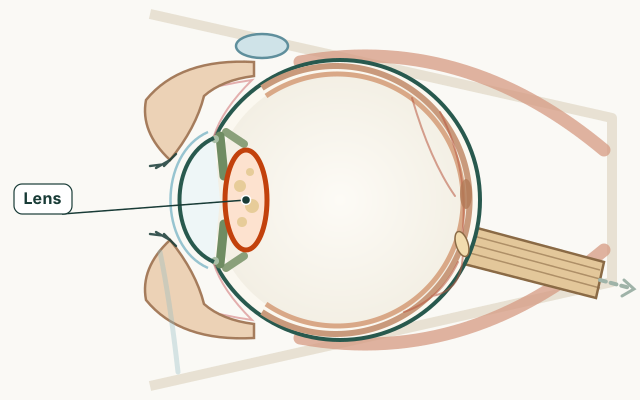
- Part of the eye
- Lens
- Common signs
- Typical: blur or mist that creeps over months or years
- Typical: glare and halos, especially oncoming headlights
- Typical: faded or yellowed colours; brighter light needed to read
- Not typical: sudden vision loss, severe pain, or a dark curtain — urgent care
- Treatment options
- Condition group
- Cornea and front of eye
- Medical code (ICD-10)
H25
What is a cataract — and who is this page not for?
A cataract is clouding of the natural lens behind the iris. Proteins clump with age — and faster with diabetes, long-term steroids, smoking or heavy UV — so light scatters and vision turns misty. Most people notice this over years, not hours. Skip this page and seek urgent care if vision drops suddenly, a dark curtain appears, or pain and redness arrive with the change.
Both eyes are often involved, but one is usually ahead. Cataracts do not jump from person to person. They are not an infection and they are not “eye strain from screens”, even though glare at night can feel similar to tiredness.
NHS and college guidance describe surgery as the only way to remove a visually significant cataract; drops are not a cure. We checked that public position in August 2026 on the NHS cataract pages and the College of Optometrists’ public advice. Exact waiting times and funding rules are local — we do not invent them.
What symptoms are typical — and what is not a cataract?
Typical cataract symptoms are gradual and painless: misty vision, glare or halos on night drives, colours looking washed or yellow, and glasses that need changing more often. Double vision in one eye can occur. Sudden painless loss, flashes with a shower of new floaters, or a curtain over vision are not how cataracts present — treat those as emergencies.
- Typical: blur or mist that creeps over months or years
- Typical: glare and halos, especially oncoming headlights
- Typical: faded or yellowed colours; brighter light needed to read
- Not typical: sudden vision loss, severe pain, or a dark curtain — urgent care
- Not typical: a white pupil in a child’s photo — that needs urgent examination
When is surgery the right next step — and who should wait?
Surgery is offered when the cataract gets in the way of reading, driving, work, hobbies or confidence — not merely because a clinician can see lens clouding. People who still meet their legal driving standard and manage daily tasks can often wait with updated glasses and brighter lighting. Diabetes, the need to view the retina, or a large difference between eyes can bring the conversation forward.
There is no prize for operating on a cataract that does not bother you. There is also no virtue in delaying once glare or blur is unsafe — especially for night driving. An optometrist can say whether you still meet local visual standards; they cannot issue a surgical date.
Who should not treat this as a leisurely decision: anyone whose cataract is blocking the view of diabetic retinopathy or macular disease, or anyone who has already failed a driving standard because of glare. Those are clinical timing questions for your own team.
How does cataract surgery work?
The usual operation is phacoemulsification: the cloudy lens is broken up through a small opening and an intraocular lens (IOL) is placed in the capsule. Most people have local anaesthetic drops or a small injection and go home the same day. The operation treats the cataract; the lens type decides where your clearest focus sits afterwards.
Serious complications are uncommon, but no operation is risk-free. Your surgeon should name infection, swelling, refractive surprise, and the small chance of needing further procedures. We do not publish a single global “success percentage” because published figures vary by eye health, surgeon case-mix and how “success” is defined.
Second-eye timing is usually weeks later, once the first eye is stable. Same-day bilateral surgery exists in selected pathways; it is not the default everywhere. Ask what your hospital actually offers.
Will I need glasses after surgery?Cataract surgery after laser eye surgery
Which lens implant should I consider?
There is no single best lens. A monofocal set for distance is the usual NHS starting point and still needs reading glasses for most people. Toric designs add astigmatism correction. EDOF and multifocal lenses trade a wider focus range for a higher chance of halos or glare. The power is calculated from biometry in clinic — never from an online estimate or this website.
Premium options are not on every NHS list. Private menus are wider and cost extra; they still need a healthy cornea and retina. If you have had LASIK or PRK, say so early — formulas change. Use the conversation-prep tool to turn daily priorities into questions; it does not pick a lens for you.
Lens families compared — goals and trade-offs, not a ranking
| Lens family | Main goal | Usual glasses still needed | Who it is often not for |
|---|---|---|---|
| Monofocal | One clear focus, usually distance | Near / reading for most people | Anyone promised “no glasses ever” |
| Toric monofocal | Distance plus regular corneal astigmatism | Near / reading still common | Irregular astigmatism or unstable cornea |
| EDOF | Distance plus more intermediate (screens) | Fine print often still needs help | People who reject any night-halo risk |
| Multifocal / trifocal | Distance, intermediate and near range | Some still use glasses for dim print or night | Significant macular, glaucoma or night-driving worry |
| Monovision | One eye distance, one nearer | Depends on adaptation | People who cannot tolerate imbalance |
Which lens for cataract surgery?Monofocal vs multifocal lensesLens conversation prep
Can I drive, work and live normally with cataracts?
Many people keep working and driving in daylight for a long time, then drop night driving first because glare is the limiter. You must meet the legal visual standard where you live — in the UK that is a clinical and legal test, not a feeling that “it seems fine”. An optometrist can measure; they cannot waive the law.
Work that needs fine near vision or night shifts may force the surgery conversation earlier than a retired reader’s timeline. That is a lifestyle verdict, not a moral one. Stronger glasses and better lighting are reasonable while you wait; they do not melt the cataract.
When is sudden vision change an emergency?
Cataracts do not cause a sudden black-out, a curtain, or a painful red eye. Those patterns point to retinal detachment, vascular occlusion, acute glaucoma or infection until proven otherwise. Seek emergency assessment the same day. Do not book a routine cataract slot and wait.
Are eye floaters dangerous?When are flashes an emergency?What does sudden vision loss mean?Support cataract charityWorld Aid Network cataracts programmeGift of Sight appeal
Explore the diagram
The clear lens sits behind the iris. It helps focus light onto the retina at the back of the eye.
A cataract makes the lens cloudy. Light becomes scattered, so vision may look hazy and bright lights may cause glare.
- Lens
- Retina
- Optic nerve
Simplified educational diagram. It does not show what every person sees or replace an eye examination.
Practical guides
Treatments & Surgery
Frequently asked questions
Can eye drops cure cataracts?
No. No drops are proven to reverse cataracts. Surgery is the only effective treatment when vision needs improving. Be wary of products that claim otherwise.
Is cataract surgery safe?
It is one of the most common operations worldwide and is generally very safe in suitable eyes. Serious complications are uncommon. Your surgeon should still explain the risks that apply to your eyes, not a marketing average.
Can I drive with cataracts?
Only if you meet the legal visual standard where you live. Many people stop night driving first because of glare. Ask an optometrist to measure; do not guess from how the dashboard looks.
Should both eyes be done together?
Usually one eye is operated first, then the second once healing is stable. Same-day surgery on both eyes exists in some pathways but is not universal. Ask what your team offers and why.
How fast do cataracts progress?
Often slowly over years. Diabetes and steroid medicines can speed change. Regular eye tests show when daily life — not the calendar — says it is time to talk about surgery.
Will I still need glasses after cataract surgery?
Most people with a distance monofocal still use reading glasses. Other lens types can reduce glasses for some tasks but never guarantee independence. See the dedicated glasses-after-surgery answer.
Who should not use an online lens calculator?
Everyone reading this page. Lens power needs clinic biometry and a surgical plan. Our tool only prepares questions; it does not calculate power or rank a brand.
Sources for this information
These references support the information on this page. Follow the linked source for its full context.